ESCEG participates in the 1st International Congress of Public Administration of the Presidential Academy of Russia
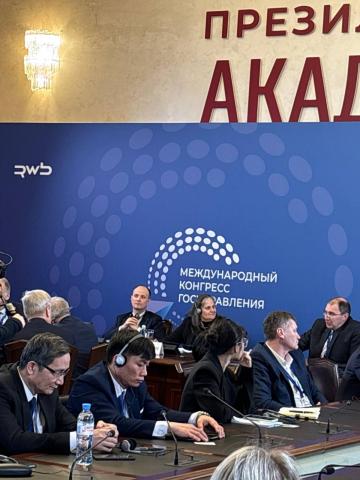
The First International Congress on Public Administration was held from February 10 to 13, 2026, at the headquarters of the Russian Presidential Academy of National Economy and Public Administration (Presidential Academy). It brought together more than 2,000 representatives of the state apparatus, including representatives from federal, regional, and municipal bodies, the business sector, and the expert community. The central strategic objective was to consolidate the professional community for the development of effective models for public administration that are oriented toward the interests of citizens and the reduction of the regulatory burden on the business sector.
The plenary session was opened with a greeting from the President of Russia, Vladimir Putin, read by the First Deputy Chief of Staff of the Presidential Administration of the Russian Federation, Sergei Kiriyenko. Participants included the Deputy Prime Minister of the Russian Federation—Head of the Government Apparatus—Dmitry Grigorenko; and the First Deputy Prime Minister of the Kyrgyz Republic, Daniyar Amangeldiev. The First Deputy Chief of Staff to the President of Russia, Sergei Kiriyenko; the Mayor of Moscow, Sergei Sobyanin; and the Rector of the Presidential Academy, Alexey Komissarov, were among the speakers.
Speakers from 12 countries (China, Vietnam, India, the United Arab Emirates, South Africa, Cuba, Brazil, Oman, Belarus, Kyrgyzstan, Tajikistan, and Kazakhstan), as well as representatives from the Russian Federation's senior management—governors, federal ministers, mayors, and senior executives of companies—discussed a wide range of current issues, such as data-driven management, AI-powered services, regional success stories, and improving the quality of public services.
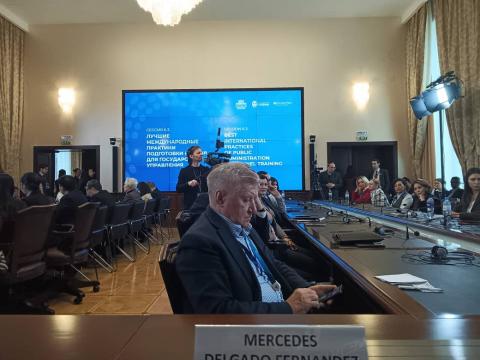
At the roundtable discussion "International Best Practices in Training Personnel for Public Administration," the Rector of the Higher School of State and Government Cadres, Mercedes Delgado Fernández, presented a paper on "Competency-Based Training for State and Government Managers in Cuba." He emphasized that, given the intensification of the U.S. government's blockade against Cuba, the competencies of public and private sector managers constitute a crucial area of research for the institution that trains future leaders. Managerial training at ESCEG is systematic, and it is emphasized that managers are servants of the people, exemplars of discipline and leadership, committed to the nation and the defense of its sovereignty, adhering to the code of ethics and legality, possessing strategic and innovative capacity, and serving as political cadres. He highlighted the significance of these cadres for Commander-in-Chief Fidel Castro Ruz... "aware that with greater responsibility comes greater obligation, with greater responsibility comes greater duty, and with greater responsibility comes greater sacrifice." For Che, the cadre was the backbone of the Revolution.
In Cuba, a model with 13 generic competencies for managers is in place: ethical behavior, leadership, strategic thinking, planning, control, teamwork, innovation, communication, decision-making, technical mastery, digital skills, continuous learning, tenacity, and optimism. These are associated with the nine meta-competencies of managers in the Russian Federation, which were assessed through manager surveys and statistical analysis. An innovation-oriented training model is being implemented, linked to the National Economic and Social Development Plan until 2030, the Five-Year Guidelines, the Annual Government Program, regulations, and institutional objectives that foster a change in mindset. The Congress states that it allows for the sharing of experiences and the transformation of common challenges into shared opportunities that will strengthen relationships and promote unity among our institutions and peoples.